

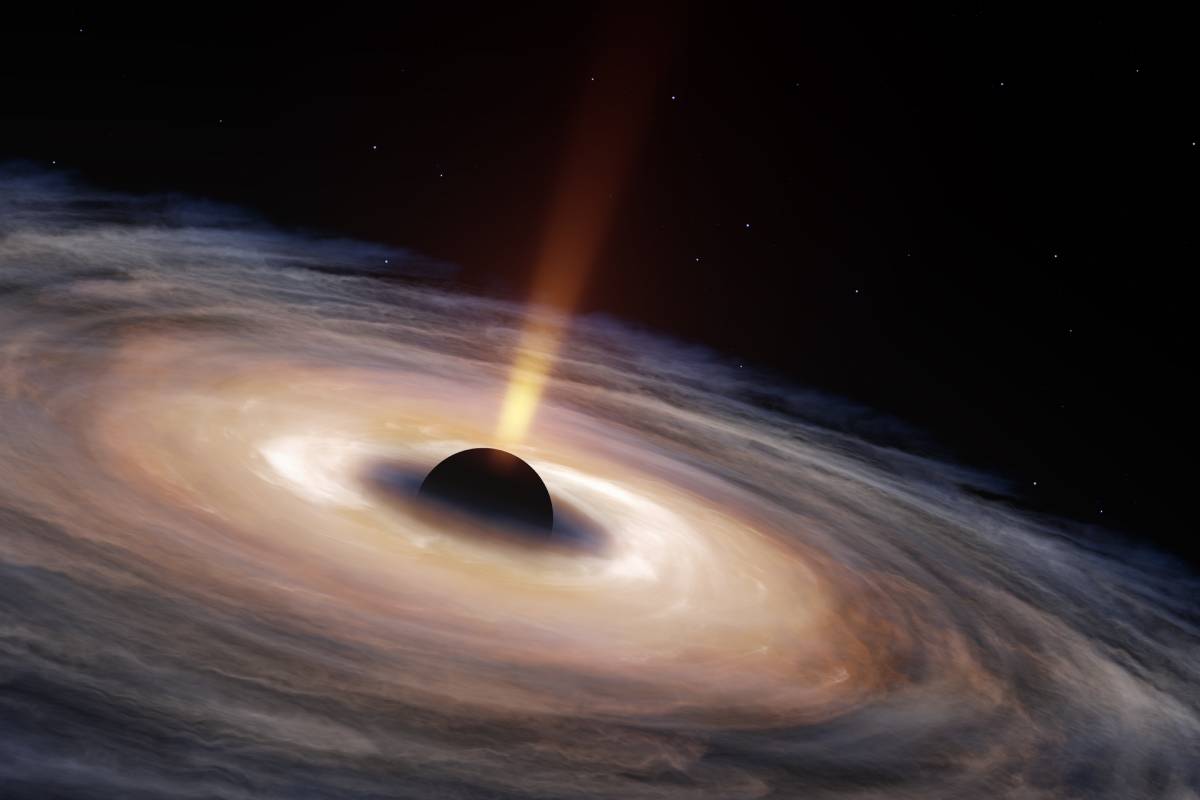
A black hole is an extreme cosmic object formed when a massive star collapses under its own gravity at the end of its life cycle. It is made of matter compressed so densely that its gravitational pull overwhelms all other forces, creating a region in space from which nothing, not even light, can escape. What exactly black holes are made of and what happens inside them remain profound scientific mysteries due to the limits of current physics, especially related to what unfolds beyond the event horizon and at the singularity.
What Is a Black Hole Made Of?
A black hole is essentially formed from matter, initially regular atomic matter such as hydrogen and helium in stars, that undergoes gravitational collapse. In a massive star’s final moments, its core collapses so intensely that atoms can no longer hold their structure. The collapse progresses beyond the stage of neutron stars, which are made mostly of tightly packed neutrons (subatomic particles), to a denser form where even these particles are thought to be crushed further into their constituent elementary particles like quarks and gluons.
In the process, the matter collapses into an incredibly small and dense point called a singularity, surrounded by the event horizon—the boundary beyond which escape velocity exceeds the speed of light. While outside the event horizon, matter has recognisable properties; inside, classical physics breaks down, and we cannot describe the matter in conventional terms. The singularity is hypothesised to be a point of infinite density and zero volume where conventional matter ceases to exist as we understand it. It might no longer be composed of elementary particles but some unknown state of spacetime-energy.
From an outside perspective, the black hole’s measurable properties are its mass, charge, and angular momentum. These define the black hole’s “identity” but reveal nothing of its internal composition because information about the matter that falls inside can never escape the event horizon.
Structure of a Black Hole
A black hole consists mainly of three parts:
- Event Horizon: The boundary around the black hole from which nothing can escape. This is not a physical surface but a point of no return. The event horizon’s radius depends on the black hole’s mass.
- Singularity: The core, theoretically a point where all the mass is concentrated in zero volume and infinite density, where the laws of physics as we know them cease to apply.
- Accretion Disk and Corona: Outside the event horizon, matter like gas and dust often gathers in a spinning disk, heating up and emitting intense light and X-rays before crossing the event horizon. Above this disk, a corona of high-energy particles exists, contributing to the black hole’s intense radiation environment.
What Happens Inside a Black Hole?
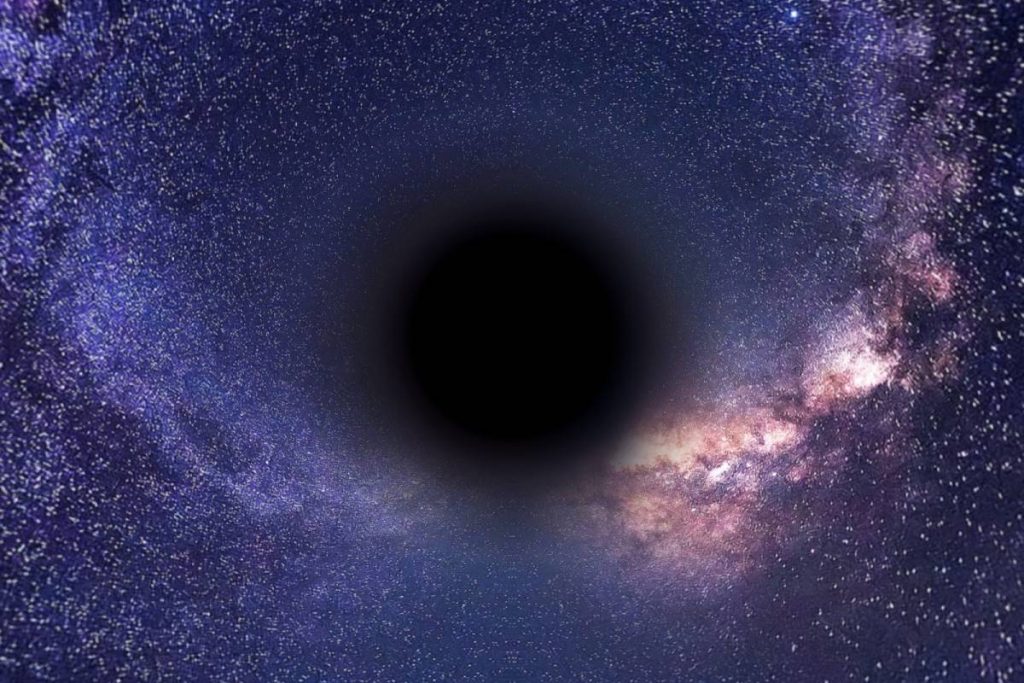
What happens inside a black hole, past the event horizon, is one of the greatest unknowns in astrophysics. Since no information can escape from that region back to the outside universe, all current knowledge about the black hole’s interior is theoretical.
Toward the Singularity
Once an object crosses the event horizon, it is inexorably drawn toward the singularity. General relativity predicts that the curvature of spacetime becomes infinitely strong near the singularity, and gravitational forces grow without bound. This leads to a state called “spaghettification,” where objects are stretched extremely in the direction toward the singularity and compressed in other directions due to the intense gravitational gradient.
Breakdown of Known Physics
Inside the event horizon, the known laws of physics break down. Classical theories like general relativity predict infinite density and zero volume at the singularity, which is physically problematic. Quantum mechanics suggests that new physics, quantum gravity, must come into play to properly describe this realm, but a complete theory is still lacking.
Some hypotheses suggest that what lies at the core is not a destructive point singularity but rather a quantum state of spacetime and matter, possibly a ring-shaped singularity for rotating (Kerr) black holes, that defies our classical understanding. The interior could be dominated by pure energy or exotic states of matter never witnessed elsewhere.
Information Paradox
A major puzzle is whether information about the matter that falls into a black hole is truly lost or somehow preserved. This “information paradox” challenges fundamental principles in physics and remains unresolved. The paradox arises because quantum theory states information cannot be destroyed, yet anything falling inside the event horizon appears to disappear from the observable universe, raising questions about how information is stored or emitted, possibly via Hawking radiation.
Conclusion
A black hole is made from matter densely collapsed beyond neutron stars into a state that may not even be describable by elementary particles. It consists of a singularity, an extreme concentration of mass and energy at a point and an event horizon, the critical boundary that nothing escapes from. Inside the black hole, conventional physics fails, and matter is crushed to a state beyond current scientific understanding, involving bizarre effects like spaghettification, infinite density, and possibly exotic quantum states of matter and spacetime.
Research continues to unravel these mysteries, but as of now, what exactly happens inside remains one of the deepest enigmas in science.